
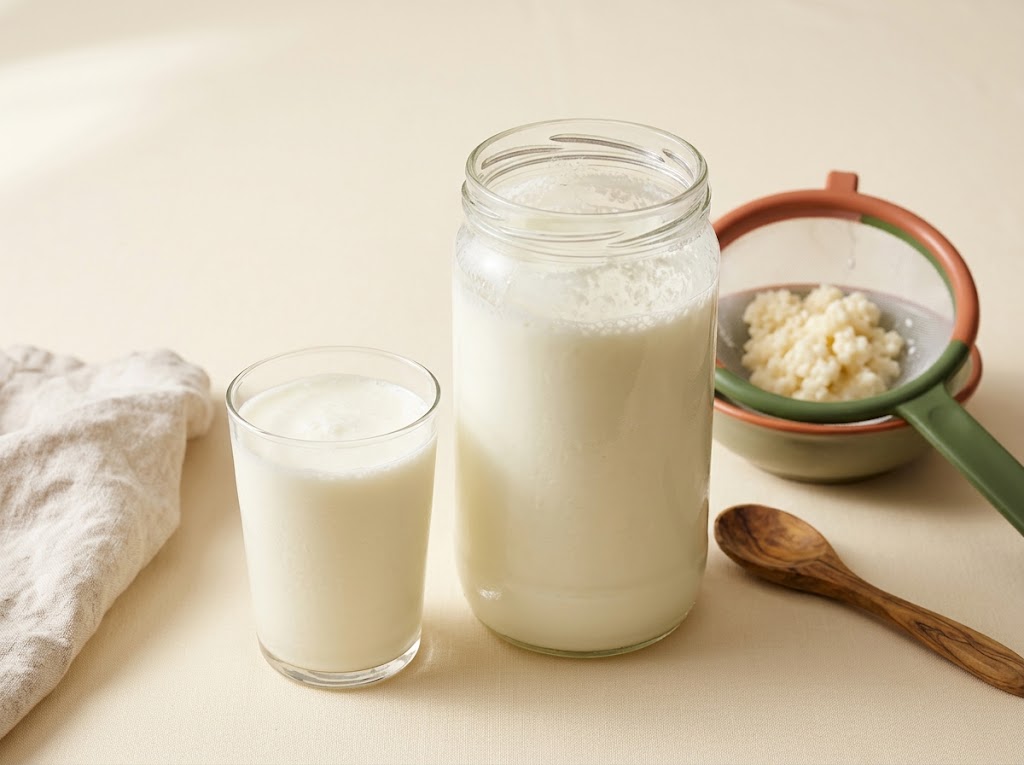
Kefir works differently from yoghurt: no heating, no starter, just kefir grains and room temperature. The grains are alive and have to be fed; if they finish the milk and go hungry they weaken and the kefir does not sour. Contact with metal is also worth avoiding, so use a glass jar and a plastic sieve.
Ingredients
For the kefir
Equipment needed
Method
-
Prepare the jar
Wash a glass jar in hot water and rinse it thoroughly, as any detergent residue kills the grains.
-
Add the grains
Put the kefir grains into the bottom of the jar.
-
Add the milk
Pour in milk at room temperature, leaving two fingers of space at the top.
-
Close it loosely
Do not tighten the lid, or stretch muslin over the top instead; the fermentation produces gas.
-
Leave it
Leave it at room temperature, out of the sun, for 24 hours.
-
Strain it
Pour it through a plastic sieve, keeping hold of the grains. The liquid that comes through is your kefir.
-
Feed the grains
Put the grains back into the same jar and add fresh milk, and the cycle continues.
-
Chill it
Leave the kefir in the fridge for 2 hours and then drink it.
Tips
- Do not use metal spoons or metal sieves; contact with metal weakens the grains.
- Do not leave the grains without milk. If you will not be using them for a while, put them in the fridge along with some milk, where they slow down but do not die.
- Left for more than twenty four hours the kefir turns too sour and gassy. In summer 18 hours is enough.
Nutrition
Values are per serving and approximate.