
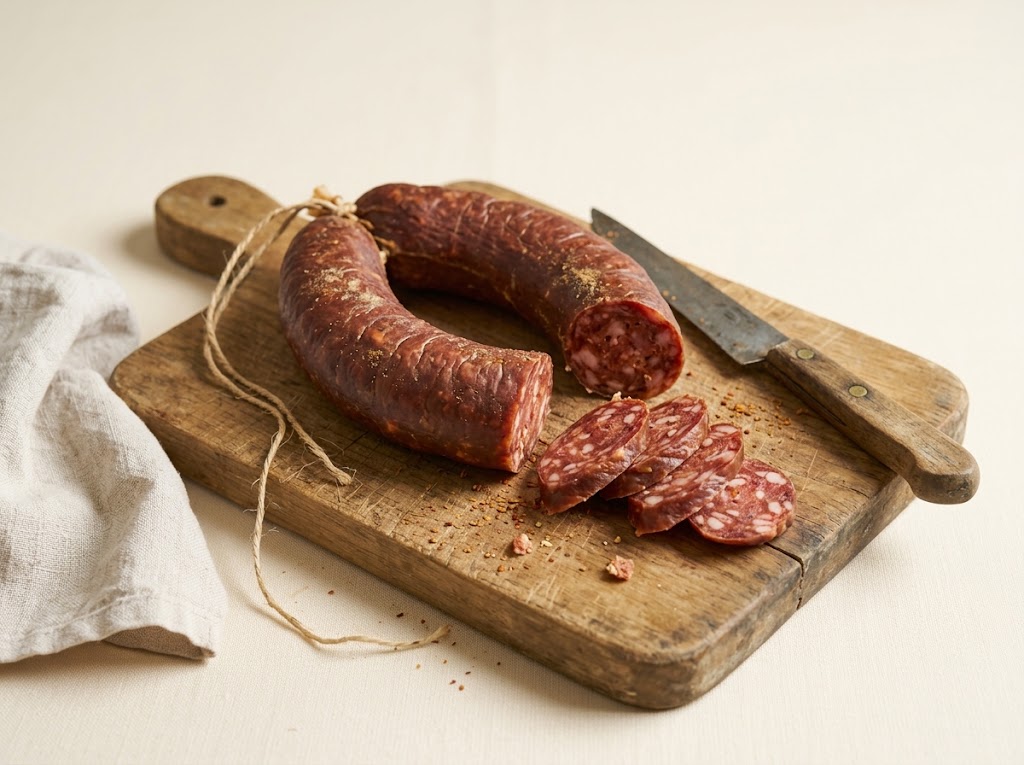
Sucuk is made by drying rather than cooking, which makes it a question of conditions rather than of a recipe. Three things are needed: a fat content of twenty five per cent, enough salt, and somewhere cool and airy. In a warm or damp place it spoils instead of drying, so it is better not attempted outside the winter months. Garlic and fenugreek are what give sucuk its smell.
Ingredients
For the mince
For the spice mix
For filling
Method
-
Knead the mixture
Knead the mince, tail fat and all the spices in a wide bowl for 15 minutes.
-
Rest it
Cover and leave it in the fridge overnight, so the spices work into the meat.
-
Prepare the casings
Soak the casings in warm water for 30 minutes and rinse them through.
-
Fill them
Fill them using the sausage funnel on a mincer, leaving no air pockets.
-
Tie them
Tie tightly with cotton string every 20 centimetres, and prick them in several places with a needle to let the air out.
-
Press them
Lay the sucuk on a flat tray, put a weight on top and leave for a day. This is where the flat shape comes from.
-
Dry them
Hang them somewhere cool, airy and out of the sun. Fifteen to 20 degrees is ideal. Leave them for 3 weeks.
-
Check them
They should be firm when you press them, and dark red inside when cut.
Tips
- Do not attempt it outside the winter months. In warm weather sucuk does not dry, it spoils.
- Do not cut back on the salt; 40 grams to 1.5 kilos of meat serves as both flavour and preservation.
- Leave no air pockets. Sucuk with air trapped inside grows mould at that point.
- A thin white bloom on the surface is normal and wipes off with a cloth dipped in vinegar. Fuzzy green mould means that sucuk is thrown away.
Nutrition
Values are per serving and approximate.