
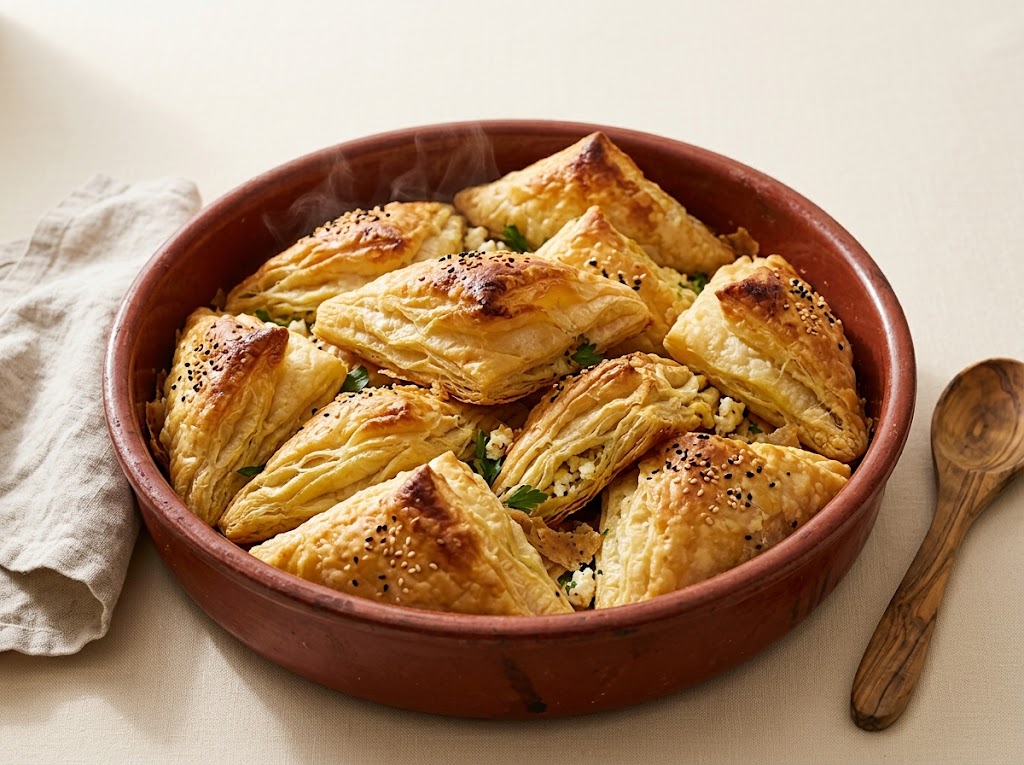
Whether these puff depends on one thing: the oil being hot enough. Pastry that goes into cool oil takes it up and turns heavy instead of puffing. The dough has to be rolled thin as well; thick dough makes no steam inside and there is no puff. Vinegar makes the dough short, so do not skip it.
Ingredients
For the dough
For the filling
For frying
Method
-
Knead the dough
Knead the flour, egg, water, oil, vinegar and salt. It should be as soft as an earlobe and not stick to your hand.
-
Rest
Cover with a damp cloth and leave for 30 minutes. Unrested dough springs back as you roll it.
-
Make the filling
Crush the cheese with a fork and mix with the parsley.
-
Roll
Divide the dough into walnut-sized pieces and roll each into a circle 2 millimetres thick.
-
Fill
Put a teaspoon of filling on half the circle, fold the other half over and press the edge closed with your fingers. Press with a fork to fix the edge.
-
Heat the oil
Bring the oil to 180 degrees. A scrap of dough should rise to the surface at once and sizzle.
-
Fry
Lower the pastries into the oil and you will see them puff. Two minutes a side, until golden.
-
Drain
Transfer to kitchen paper and let the excess oil drain off.
Tips
- Do not put a pastry in without testing the oil. Warm oil both prevents the puff and turns the pastry into an oil sponge.
- Do not skip the vinegar; it is what makes the dough short.
- Do not overfill, as the edge will not close and it opens in the oil.
- Fry no more than three at once so the oil temperature does not drop.
Nutrition
Values are per serving and approximate.