
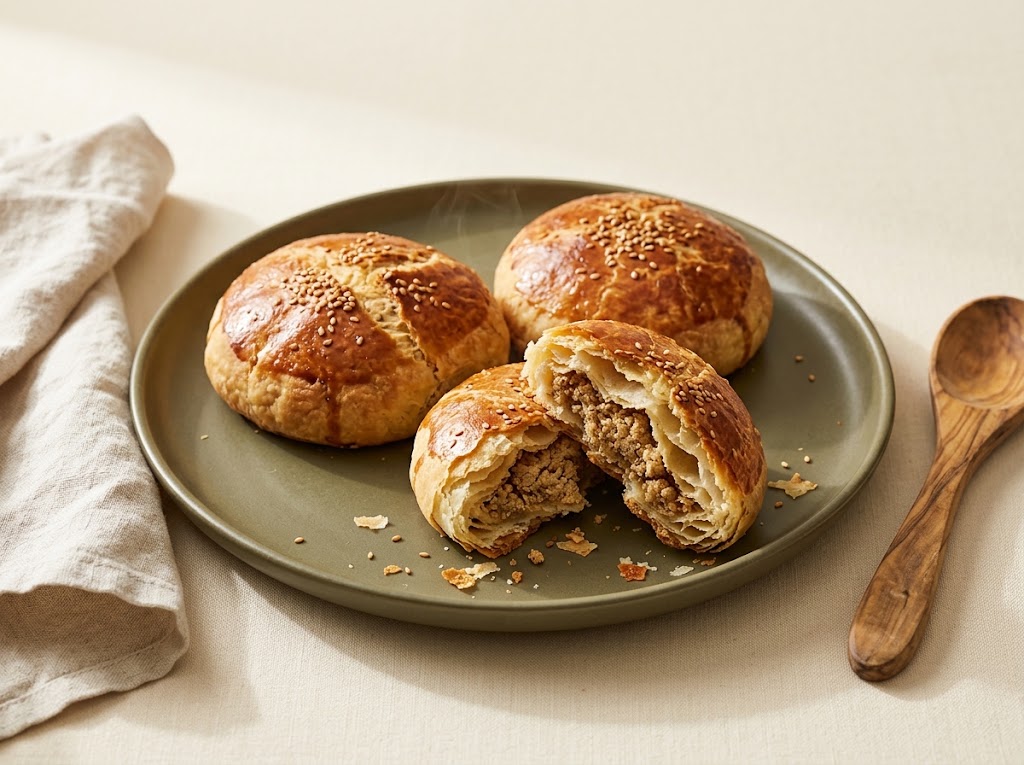
What distinguishes kete is its filling: flour toasted in butter until it turns into a sandy paste. Toast it too briefly and the flour leaves a raw taste; too long and it tastes burnt. The right point is when the colour reaches that of a pale biscuit and the smell changes. The filling must also be completely cold; hot filling melts the dough from inside and closes the layers.
Ingredients
For the dough
For the filling
For rolling out
For the top
Method
-
Toast the filling
Melt the butter, add the flour and toast over a low heat for 15 minutes, stirring constantly, until it reaches the colour of a pale biscuit.
-
Cool the filling
Spread it on a wide plate and cool it completely. This step saves the layers.
-
Knead the dough
Knead the dough ingredients for 10 minutes into a soft dough.
-
Rest
Cover and leave for 40 minutes.
-
Roll the pieces
Divide the dough into 10 pieces, roll each out thin and brush with melted butter.
-
Laminate
Roll the buttered dough into a tube and coil it like a snail, rest for 10 minutes and roll it out again. This is what gives the layers.
-
Fill
Put two tablespoons of the cooled filling in the middle, close the edges and flatten slightly.
-
Bake
Brush with egg yolk and bake at 190 degrees for 30 minutes.
Tips
- Cool the filling completely. Even warm filling wets the dough from inside and closes the layers.
- Do not leave the pan while you toast the flour; in the last three minutes the colour darkens fast.
- Do not skip the second rolling, as the layered structure comes from there.
- The next day, warm at 150 degrees for 6 minutes; kete comes back to how it was on the first day.
Nutrition
Values are per serving and approximate.